Last updated: 2026-08-03 · Written by the usedappliancestores.com data team. Store counts come from our national dataset of 6,671 active store listings, checked 2026-07-15.
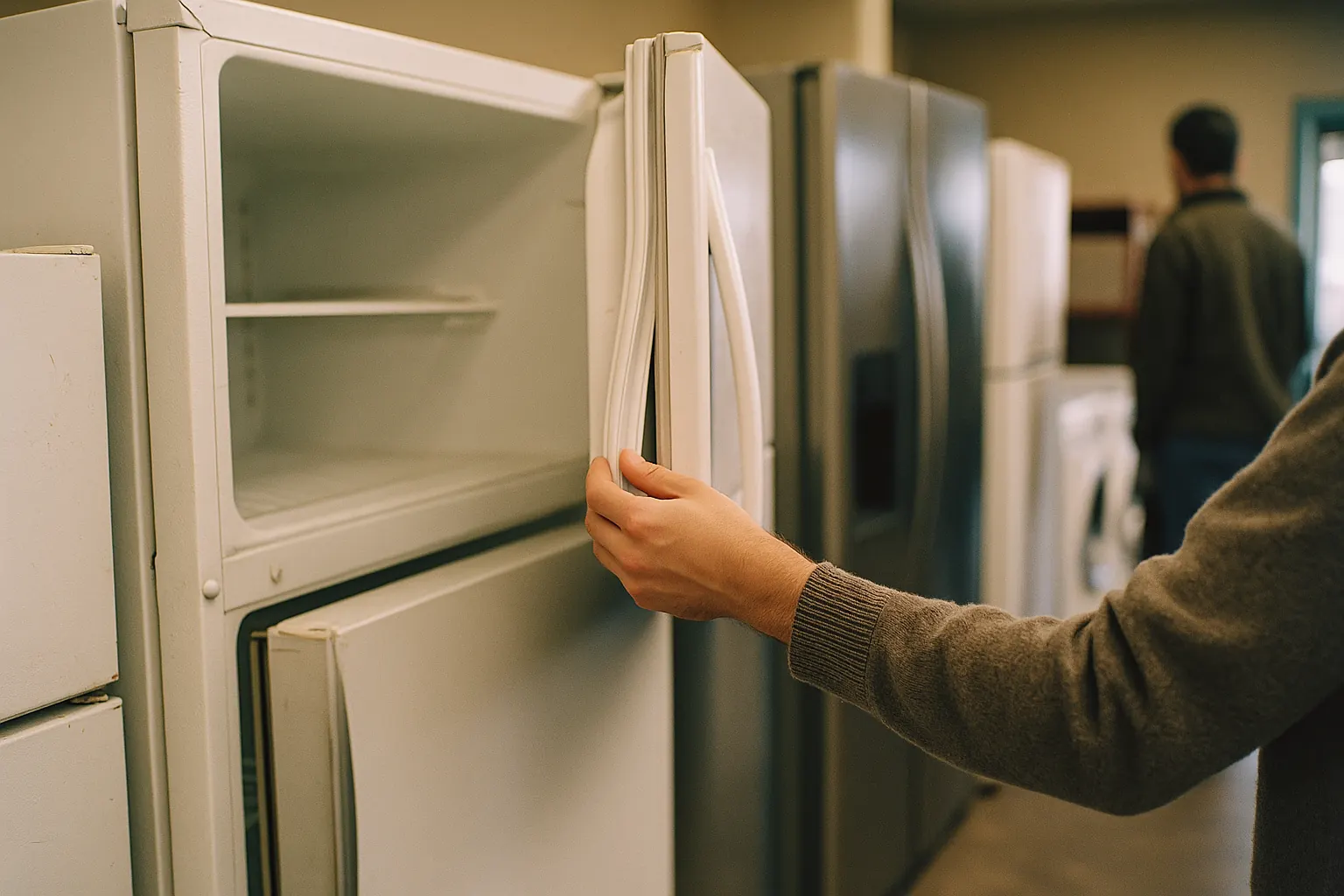
Every appliance category has one failure that totals the machine. Every one of those failures announces itself to a buyer who knows the 60-second test. A used washer's killer is its bearings, revealed by spinning the drum by hand. A refrigerator's is the sealed system, revealed by what the compressor sounds like doing its job. This page is the whole inspection, machine by machine: the universal five checks first, then the test per category, then the walk-away lines that no discount crosses. It assumes nothing but your hands, a phone flashlight, and a dollar bill.
The universal five, on any machine
- Read the rating plate before anything else. Inside the door frame or on the back panel: model number and manufacture date (decodable from the serial; the seller should read it for you). Age against the NAHB lifespan table is most of the price (used-appliance prices by type and region carries the formula: a machine past two-thirds of its expected life is a parts donor wearing a price tag).
- Ask to see it run. A store that sells working machines lets you watch them work. On a driveway purchase, the machine should be plugged in and cold, or filling, when you arrive. "It worked when we unplugged it" is a coin flip priced as a certainty.
- Level and square. A pocket level on top, or a practiced eye: a machine that does not sit flat on a flat floor took a structural hit. Doors should close flush with even gaps.
- Rust where water lives. Surface rust on a panel is cosmetic. Rust at the water paths (under a washer lid, around a dishwasher door, at a fridge's drain) is the machine telling you where it leaks.
- Smell it. Mold in a front-loader boot, burnt insulation anywhere, gas at a range's connections. The nose finds what the flashlight misses, and it works through a closed door.
Washer: the bearing is the machine
The failure that totals a washer is the drum bearing and, on top-loaders, the transmission; both live at the machine's core and neither is economically repairable on an old unit ($350 to $550 typical quotes, per the repair tables in appliance lifespan and repair vs. replace).
| The test | Time | Pass | Walk away |
|---|---|---|---|
| Spin the empty drum by hand | 10s | Smooth glide, quiet coast | Grinding, rumbling, gritty coast |
| Front-loader: grab the drum rim, lift and rock | 10s | Minimal play | Clunking vertical play: bearing gone |
| Run a spin cycle if possible | 3min | Steady tone rising | A roar that grows with speed |
| Front-loader: peel back the door boot | 20s | Clean or lightly soiled rubber | Torn boot, black mold colonies |
| Check under the machine with the flashlight | 15s | Dry pan | Oil drips (transmission) or water tracks |
The one that matters most is the hand spin. A healthy drum coasts silent; a dying bearing sounds like sand in a coffee grinder, and no deal survives that sound. Suspension is the second-tier check: shove the drum down hard once; one bounce and settle is healthy, a pogo means shocks, a $120-to-$250 repair that is negotiable but real.
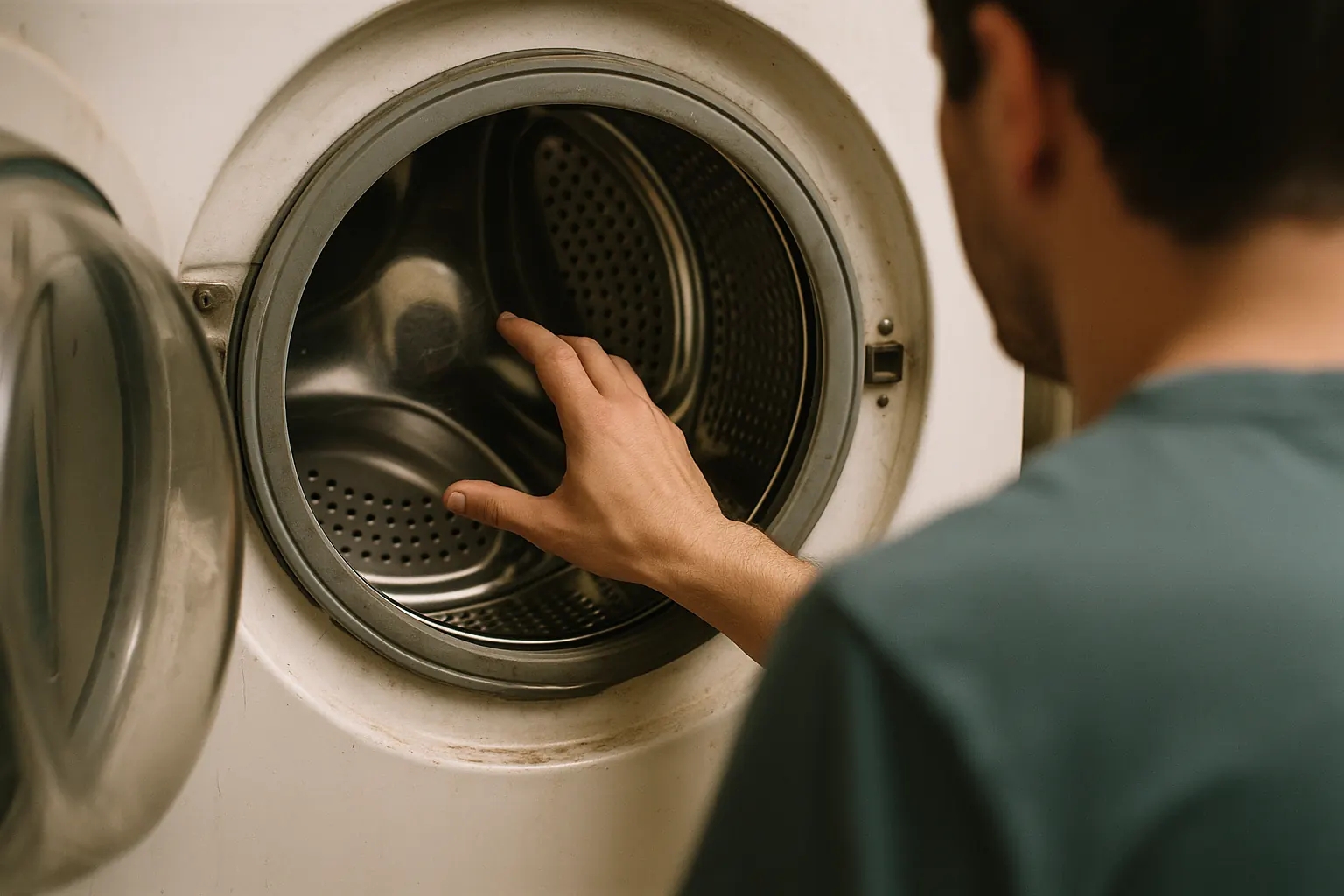
Ten seconds that price the whole machine: a healthy drum spins silent and coasts long.
Dryer: the friendliest machine on the floor
Dryers age slowly and repair cheaply (belt, rollers, element, and fuse all run $100 to $230 fitted), which makes them the safest used purchase in the lineup and the one where a minor failure is a discount, not a disqualifier.
| The test | Time | Pass | Walk away |
|---|---|---|---|
| Spin the drum by hand | 10s | Light, even resistance | Screech or flat spots: rollers |
| Run it on heat for two minutes | 2min | Warm air at the drum fast | Tumbles without heat (element/fuse: cheap, negotiate) or no tumble (motor: rare, real) |
| Open the lint path with the flashlight | 30s | Clean-ish duct | Packed lint to the housing: fire risk and a neglect signal for the whole machine |
| Check the door seal | 10s | Intact felt/gasket | Chewed seal on an otherwise rough unit |
| Gas models: sniff at the rear connection | 10s | Nothing | Any gas smell |
The neglect signal is the real finding here: a lint-packed dryer was owned by someone who skipped every other kind of maintenance too. On electric models, note the plug: 3-prong versus 4-prong must match your outlet, and the cord usually is not included, a $15-to-$25 line in the landed cost. Gas dryers use an ordinary 120V cord and almost always keep it (cheapest way to replace a washer or dryer itemizes the rest).
Refrigerator: listen to the compressor, squeeze the gasket
The totaling failure is the sealed system (compressor, evaporator, condenser: $600 to $1,200 quotes against machines usually worth less), and the cheap failures that mimic it (start relay, fans, defrost) are exactly what a running test distinguishes.
| The test | Time | Pass | Walk away |
|---|---|---|---|
| Listen at the back, running | 30s | Low steady hum, occasional soft click on cycle | Click-click-click every few minutes (relay: cheap) vs hum-then-die (compressor: fatal) |
| Cold check | 10s | Freezer freezing, fridge fridge-cold | Running for hours, barely cool |
| Dollar-bill test on the gasket, all four sides | 30s | Real drag at every point | Bill slides free: dried gasket ($50-100, negotiate) |
| Flashlight on the freezer back wall | 10s | Clean panel | Solid ice sheet: defrost system |
| Look under and behind | 20s | Dry, dusty is fine | Oily residue at the compressor: sealed-system weep |
The auditory distinction is worth learning before you go. The repeating click is usually a $30 start relay, and it is always a negotiating position; the only true test is swapping that relay, so price the unit as if the click might be the compressor and be pleased when it is not. The hum that dies after a few seconds is the compressor failing to start, and that machine is done, no matter how clean the shelves are. On a driveway sale where the unit sits warm and unplugged, the machine is untestable, and untestable prices at the bottom of the market, per the channel table in best places to buy used appliances. If the fridge you are replacing is the emergency itself, the triage order (and what revives dead fridges free) is in refrigerator died cant afford a new one.
Range: the simplest test, the strictest safety line
Ranges are mechanically the simplest and longest-lived category (13 to 15 years, NAHB), with cheap fixes (igniters, elements, switches at $80 to $250) and one expensive exception: the control board on electronic models.
| The test | Time | Pass | Walk away |
|---|---|---|---|
| Light every burner | 60s | Gas: steady blue, ignites in ~4s. Electric: glows evenly | Yellow lazy flames; endless clicking; an element with dead zones |
| Oven to 350°F | 10min | Climbs steadily, then holds | Stalls short of temperature, or swings wildly (board/sensor on electronic models) |
| Door and hinges | 15s | Closes flush, no sag | Sagging door: hinge or frame |
| Gas: smell test at the rear, valves off | 10s | Nothing | Any gas smell, ever |
| Knobs and panel | 20s | All present, firm detents | Melted panel, missing knobs on an electronic model |
The safety line is absolute on gas: any gas smell at the connections or a flame that burns yellow and lazy is a walk-away on the spot, not a negotiation. A blue-flame gas range with mechanical knobs, on the other hand, is the closest thing this market has to a machine that cannot die, which is why it holds value used better than anything else on the floor.
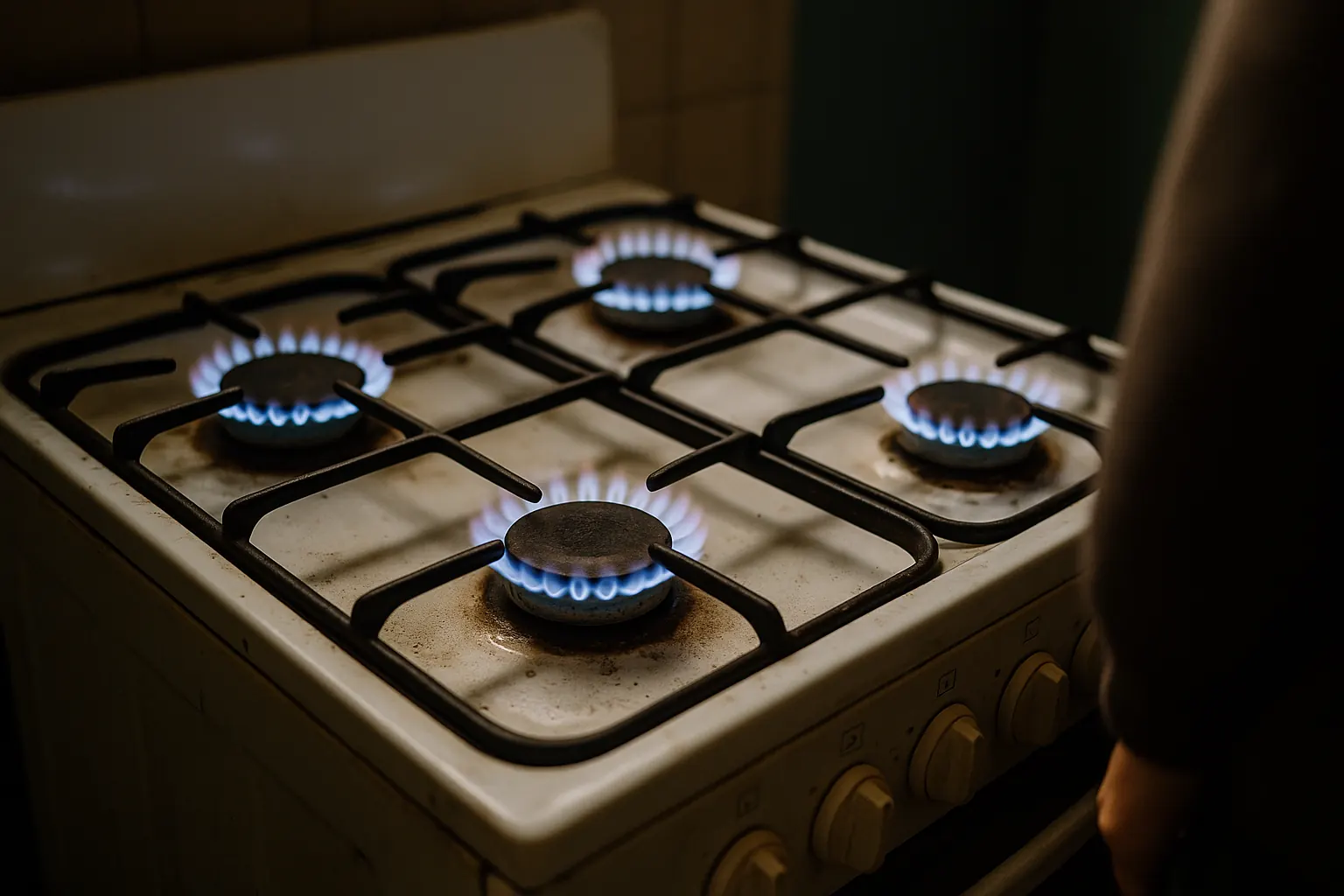
The pass condition, photographed: steady, blue, and even, on every burner, within seconds.
Dishwasher, briefly, because the math is different
The shortest-lived major (~9 years) with mid-cost totaling failures (pump and board, $300 to $500) means used dishwashers past mid-life rarely justify any price. If you inspect one anyway: run a fill, listen to the pump (whine bad, hum fine), check the door gasket and latch, confirm the racks exist and roll (racks are priced as accessories, $50-plus to replace), and flashlight the sump for standing sludge. The scratch-and-dent channel serves this category better than the used channel, per the category table in is buying used or scratch-and-dent worth it.
What should you bring, and what should you ask?
The kit is pocket-sized. A phone with its flashlight and camera. A dollar bill for gaskets. A small level, or the phone's level app. A tape measure, and the photographs of your outlet, your hookups, and your doorway, taken before you left. The camera earns its place twice: photograph the rating plate the moment you find it (model and serial settle every later question, from parts lookups to warranty registration), and photograph any damage you negotiated on, next to the receipt.
While your hands run the tests, three questions run the seller, and the answers are checks in themselves:
- "Where did this unit come from?" Trade-in, freight damage, apartment buyout, estate lot: each answer carries its own risk profile, mapped channel by channel in where do used appliance stores get their inventory, and a seller with no answer at all is a finding too.
- "What did you do to it before flooring it?" "Tested a full cycle and replaced the belt" is a store doing its job. "Cleaned it up" means your inspection is the only one it ever got.
- "What happens if it dies in two weeks?" The written-guarantee answer changes what every failed check below costs you, and the state-law floor under that answer is in used-appliance warranty rights by state.
Sequence the visit like this: rating plate first (age kills deals faster than any mechanical check, so run it before falling for the machine), then the universal five, then the category table, then the three questions, then arithmetic. Ten to twelve minutes for one machine, and the order matters because each stage can end the visit before the next spends your time.
When a failed check is a discount, and when it is a door
The line that organizes everything above: edge parts negotiate, core parts walk. A gasket, a belt, a relay, an element, a hose, a roller, an igniter: these are the machine's edges, cheap and replaceable, and a failed edge check is a specific dollar figure you subtract at the counter, out loud. Bearings, transmissions, compressors, sealed systems, control boards, bent frames: these are the core, and a core symptom at any price is buying someone else's disposal problem. The store's paper decides how much this distinction matters. With a written 90-day guarantee, a missed diagnosis is the store's problem. On an as-is ticket it is entirely yours. That is why the same machine is worth real money more from a seller who writes things down; used-appliance warranty rights by state covers what that paper is worth in your state.
And inspect the seller with the same rigor as the machine: 29% of the 9,409 candidate stores we assessed nationally failed identity or operating checks before a single drum got spun. The store checklist is how to verify a used-appliance store; the checked stores near you are on the browse checked stores by state.
Sources
- National Association of Home Builders / Bank of America, Study of Life Expectancy of Home Components, 2007 (per-category lifespans).
- Repair-quote ranges: typical out-of-warranty parts-plus-labor ranges, consistent with the tables in our repair-vs-replace guide; stated as ranges, not a survey.
- usedappliancestores.com store dataset, 2026-07-15 build: 6,671 active listings; screening-funnel figures.