Last updated: 2026-08-03 · Written by the usedappliancestores.com data team. Store counts come from our national dataset of 6,671 active store listings, checked 2026-07-15.
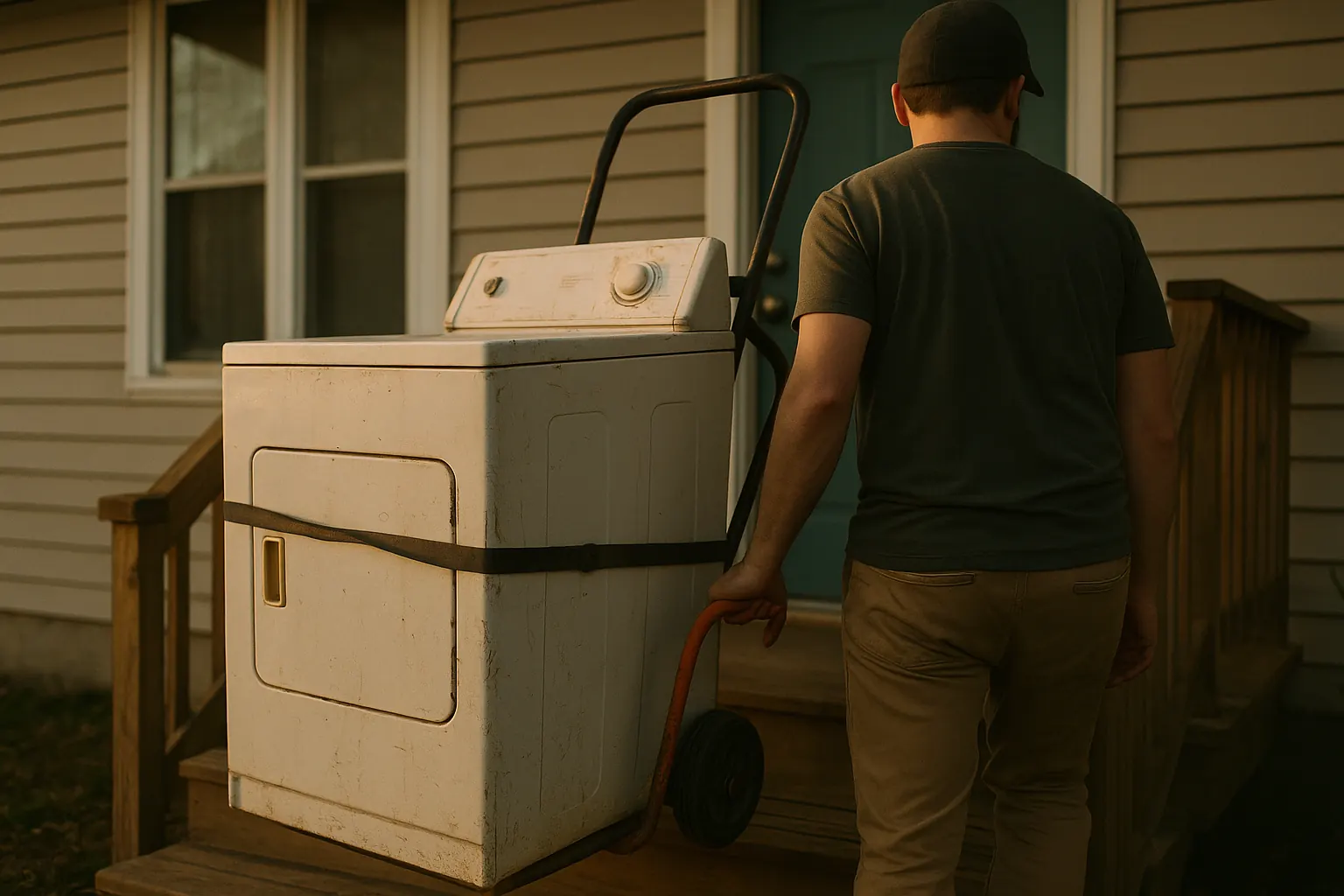
The cheapest replacement is a tested used unit you haul yourself: typically $150 to $300 for a washer with real life left, $100 to $250 for a dryer, plus $15 to $30 of new hoses and an afternoon. The most expensive "cheap" replacement is the wrong unit bought fast: wrong size for the closet, wrong plug for the wall, or a machine so old it dies again by spring. This page prices the whole job through every channel, landed, because the sticker is less than half the story: the unit, the delivery, the connections, the haul-away of the dead one, and the laundromat bill that keeps running while you decide.
The meter that is already running
While the machine is broken, the laundromat is the interim plan, and it prices the urgency: machines run $3 to $6 a load in machine fees, so a household doing five loads a week is spending $15 to $30 weekly, $65 to $130 a month, on not deciding. That number does two jobs. It caps how long patience pays (six weeks of hunting for a $50 better deal is a wash), and it makes the free and near-free rungs below worth an aggressive first look, because their real price is mostly your time, and the meter prices your time.
A dryer-only failure has a cheaper meter: wash at home, line-dry or laundromat-dry. A washer failure runs the full meter. Two machines dead runs it double. Match the urgency to which machine actually died before paying for speed you do not need.
What "landed" includes, before any channel
| Cost line | Typical range | Notes |
|---|---|---|
| The unit | see ladder below | |
| Delivery | $50-150, or $20-40 DIY truck/trailer rental | Upright is always safe; on-side only with the drum braced (front-loaders want their transit bolts) |
| New fill hoses (washer) | $15-30 | Never reuse old hoses. A burst hose floods a house; braided stainless is cheap insurance |
| Vent kit (dryer) | $10-25 | Crushed foil vents cause long dry times and lint fires; rigid or semi-rigid beats foil |
| Power cord (dryer, electric) | $15-25 | Dryers often sell without cords, and 3-prong vs 4-prong must match YOUR outlet |
| Gas connector (dryer, gas) | $15-25 + shutoff check | New flex connector every install; soap-bubble test the joint |
| Haul-away of the dead unit | $0-75 | Often free with dealer delivery; municipal bulk pickup; scrap collectors often take laundry free |
| The overhead beyond the sticker | $40 to $230 | The number that reorders the ladder below |
The overhead is why a $250 delivered-installed-hauled dealer unit routinely beats a $180 marketplace unit plus $40 truck plus $25 hoses plus your Saturday: the arithmetic lands within $30 either way, and one of the two comes with a written guarantee. Run the numbers per channel, not the stickers.
The ladder, cheapest landed cost first
| Rung | Channel | Typical unit price | Realistic landed cost | What you give up |
|---|---|---|---|---|
| 1 | Free: curb alerts, buy-nothing groups | $0 | $40-70 (truck, hoses) | History, testing, and sometimes the reason it was free |
| 2 | Estate sales and auctions | $20-80 | $60-150 | Dormancy risk; no power outlet to test with |
| 3 | Marketplace, tested at the seller's home | $100-250 | $150-320 | All recourse; the test is your only protection |
| 4 | Nonprofit resale | $75-200 | $115-270 | Selection is luck; rarely delivered |
| 5 | Independent used dealer, written guarantee | $150-350 | $200-420 delivered | The least, which is the point; see below |
| 6 | Scratch-and-dent outlet | $350-600 | $400-700 delivered | Nothing mechanical; you pay for new internals |
Dryer discount: a used dryer runs $50 to $100 cheaper than a comparable washer at every rung, because dryers are mechanically simple and age slowly. The same simplicity means an old dryer is a safer gamble than an old washer, so the free and cheap rungs are stronger plays for dryers than for washers. The full repair-economics picture behind that asymmetry is in appliance lifespan and repair vs. replace.
The age arithmetic guards every rung. A $150 washer at 8 of its ~10 expected years costs $75 a year of remaining service; a $275 washer at 4 years costs $46 a year. The lifespan math in used-appliance prices by type and region is one division, and it regularly flips which listing is "cheapest." Read the manufacture date off the rating plate before money moves; it is inside the door or on the back panel of every machine.
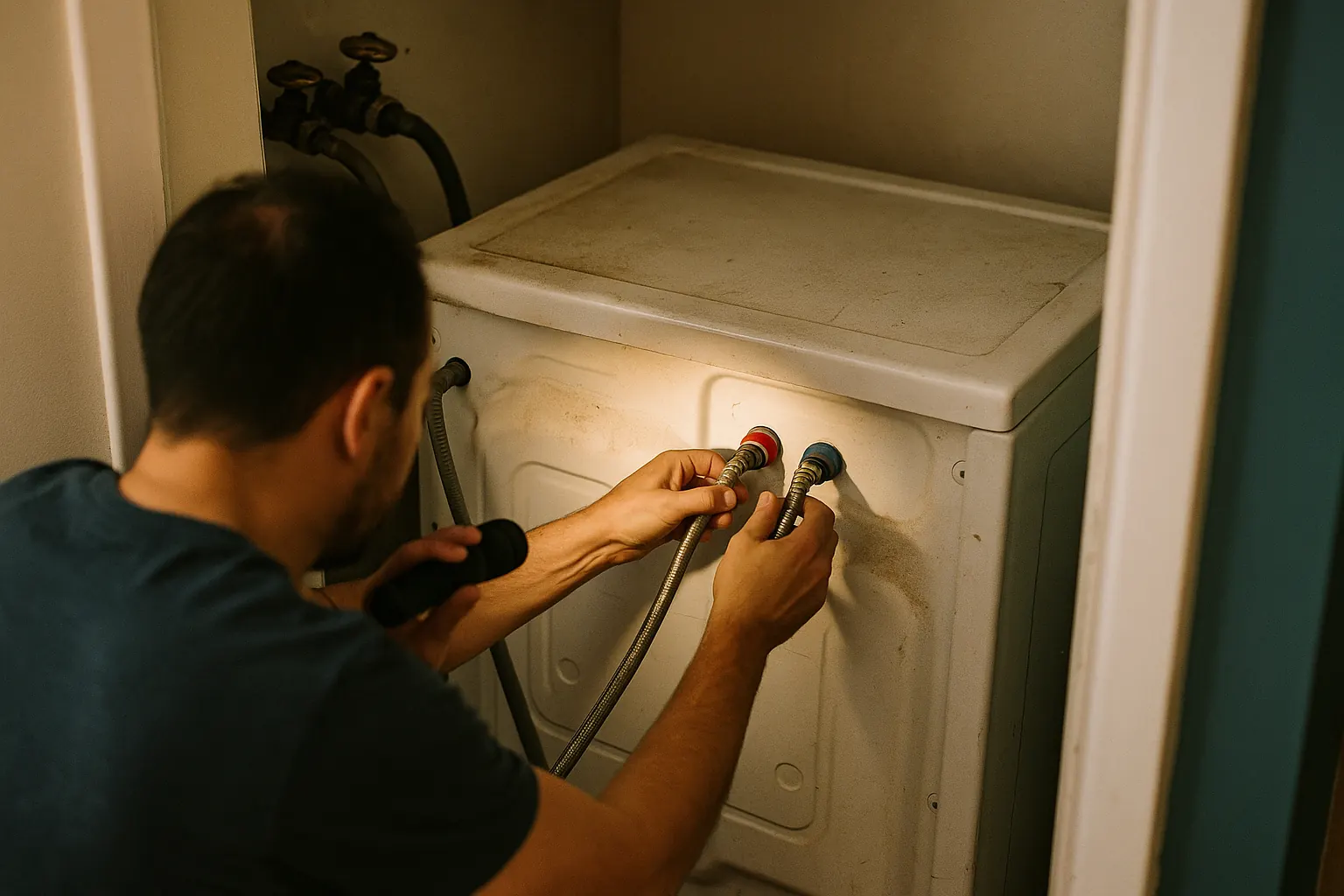
The $20 that protects the house: new braided hoses, hand-tight plus a quarter turn, and the water on slowly the first time.
Moving it yourself without breaking it, or you
Half the ladder's savings assume self-haul, so the mechanics of the haul are part of the price. The short course:
- Rent the right metal. An appliance hand truck with a strap ($15 to $25 a day where trucks are rented) is the difference between a controlled roll and two people improvising with a furniture dolly. Stairs want a third person or a stair-climbing dolly.
- Washers ride upright, with the drum secured. Front-loaders shipped new carry transit bolts that lock the drum; ask the seller if theirs survived, and if not, wedge the drum still with blankets. An unsecured front-loader drum bouncing through a truck ride can arrive with the exact bearing problem you inspected against.
- Dryers are the light ones. 100 to 130 pounds against a washer's 150 to 230. If only one machine gets professional delivery, make it the washer.
- Doorways strip, machines do not. Doors come off hinges in two minutes; washer corners do not compress. Measure the machine, then the openings, then the tightest turn, before renting anything.
- Strap it standing, drive like it is furniture. Machines ride against the cab wall, strapped at the top third, and a washer that tips at 40 mph is done in a way no inspection catches beforehand.
Budget the move honestly: truck or trailer $20 to $40, straps and blankets if you own none $20, pizza for the second pair of hands, call it $50 to $80 all-in. That number belongs in the landed-cost column every time "you haul" appears in the ladder.
Three buyers, three right answers
The ladder is not one-size; the same arithmetic lands differently by situation:
| The buyer | The situation | The right rung, and why |
|---|---|---|
| The tenant with a truck-owning brother | Washer died, $200 available, handy household | Rung 3: a tested $150 marketplace unit plus $30 of hoses and a favor. Total ~$180, running this weekend |
| The single parent, no truck, no slack in the week | Washer died, ~$350 available, zero capacity for a second failure | Rung 5: dealer unit, written guarantee, delivered, installed, corpse hauled. Total ~$300-400, and the guarantee absorbs the risk the budget cannot |
| The landlord furnishing a rental | Unit turning over next month, cost per year is everything | Rung 2 or 3 for a dryer, rung 5 for the washer: dryers gamble well, washers in rentals earn their guarantee |
The pattern: the tighter the margin for error, the more the written guarantee is worth, and the more slack (time, truck, tools) a household has, the deeper down the ladder the real bargain sits. Slack is a currency; the ladder converts it to dollars.
The four mistakes that cost more than any channel choice
- Buying a machine that does not fit. Measure the space, the door it enters through, and every hallway turn, then subtract an inch. Laundry closets have finished openings; stacked kits have height requirements; front-loaders need door-swing room. A machine that does not fit costs a restocking argument at a dealer and is simply yours forever from a marketplace.
- Wrong power or fuel. Electric dryers need a 240V outlet, and 3-prong versus 4-prong must match the wall, with the cord sold separately more often than not. A gas dryer in a home with no gas line is a paperweight. Photograph your outlet and your hookups before shopping; it settles every question at the counter.
- Reusing the old hoses and vent. The $25 you save reusing brittle hoses is the cheapest flood insurance you ever declined. Same for the crushed foil vent: long dry times read as "broken dryer" and are actually a $15 vent kit.
- Skipping the test because the price was good. On any used unit: spin the drum by hand and listen for grind, run a fill-and-spin cycle where at all possible, and check the door seal and boot for mold and tears on front-loaders. The complete machine-by-machine routine is in how to inspect a used appliance before buying, and it is never more worth ten minutes than at rungs 1 through 3, where no paper protects you.
Where do you actually find the cheap supply?
The used-laundry supply is the deepest corner of the used-appliance market: laundry pairs dominate trade-in and property-turnover channels (where do used appliance stores get their inventory maps those pipelines), and 1,987 of the 6,671 active stores in our directory show positive evidence of used inventory, across all 50 states (checked 2026-07-15). The finding problem is real, though: only 48.0% of these stores have a live website and only 28.5% publish a checkable phone number, so the marketplace listings you can scroll are a minority of the actual floors near you. The directory exists for exactly this: start at the browse checked stores by state, call, ask "used washers in stock under $300, delivered?", and you will usually be installing this week.
If the store checks out (how to verify a used-appliance store) and offers a written 90-day guarantee at rung-5 pricing, that is the strongest cheap outcome this page knows about. If even rung 1 is out of reach this month, the no-cash and no-credit routes, including the assistance layer, are priced in buying appliances with bad credit.
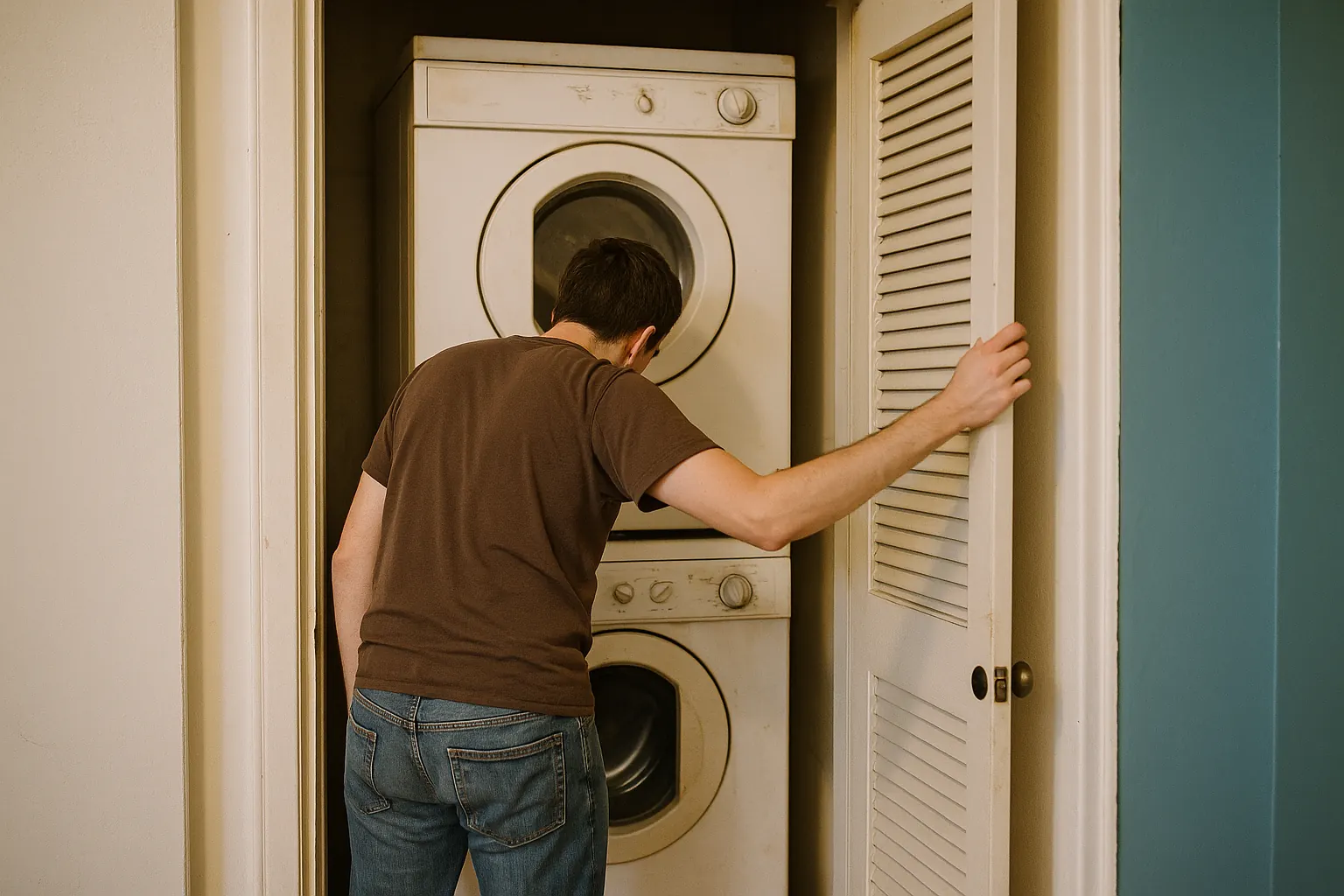
The measurement mistake, avoided: the pair that fits the closet, the doorway, and the hallway turn it traveled through.
The one-paragraph version
Triage which machine died and let the laundromat meter set your urgency. Measure the space and photograph the hookups. Work the ladder from free upward, with the manufacture-date division deciding between candidates, and price every option landed: unit plus delivery plus hoses or vent plus haul-away. Never reuse hoses, never skip the test, and remember that a dealer's delivered-and-guaranteed $250 and a marketplace's hauled-it-yourself $180 are usually the same money wearing different risk. Cold arithmetic, warm laundry.
Sources
- usedappliancestores.com store dataset, 2026-07-15 build: 6,671 active listings; used-inventory evidence, website and phone coverage.
- National Association of Home Builders / Bank of America, Study of Life Expectancy of Home Components, 2007 (washer ~10 years, dryer ~13).
- Laundromat per-load machine fees and accessory price ranges: typical posted retail prices, 2026 spot checks; stated as ranges, not a survey.