Last updated: 2026-08-03 · Written by the usedappliancestores.com data team. Store counts come from our national dataset of 6,671 active store listings, checked 2026-07-15.
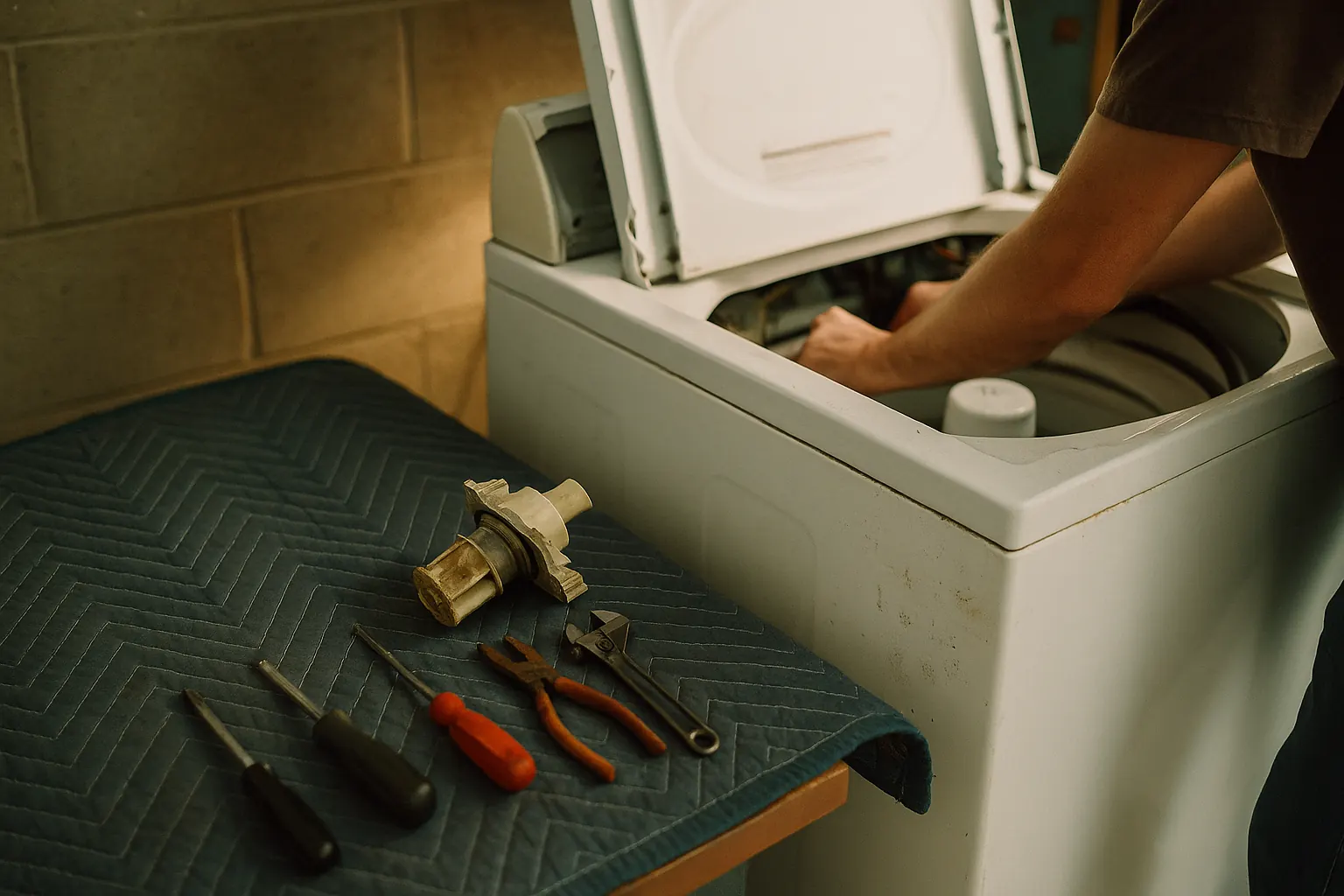
A major appliance lasts 9 to 15 years depending on the category, and the repair-or-replace call comes down to two numbers: the unit's age against that expected lifespan, and the repair quote against the cost of a comparable replacement. The widely used industry rule of thumb says replace when the repair costs more than half of a comparable replacement. The age-adjusted version below is stricter and more useful, and the per-machine tables tell you which failure you are probably looking at before anyone quotes you anything.
Expected lifespans
The most-cited public dataset remains the National Association of Home Builders' Study of Life Expectancy of Home Components (2007, prepared with Bank of America). Its figures for major household appliances:
| Appliance | Expected lifespan (years) |
|---|---|
| Dishwasher | ~9 |
| Microwave (built-in) | ~9 |
| Washing machine | ~10 |
| Freezer | ~11 |
| Refrigerator | ~13 |
| Dryer | ~13 |
| Electric range | ~13 |
| Gas range | ~15 |
Honest caveats travel with the table. The study is dated 2007 and reports averages; usage intensity, water hardness, and maintenance move individual units substantially in both directions. A washer doing ten loads a week in a hard-water county is older than its birth date says. No newer public dataset of comparable citation weight has replaced this study, which is itself worth knowing: newer "lifespan" figures on retailer blogs are usually this same table, restated without attribution.
The math: should you repair or replace?
Two thresholds, applied in order:
- The cost threshold. If the repair quote exceeds ~50% of the cost of a comparable replacement, replace. This is the standard industry rule of thumb; it exists because a major repair on an aging unit does not reset the other components' clocks.
- The age adjustment. Scale the threshold by remaining life. A unit past two-thirds of its expected lifespan deserves a stricter bar: repair only if the quote is under ~25-30% of replacement cost, because the next failure is already accruing.
| Unit's age vs. expected lifespan | Repair if the quote is under |
|---|---|
| Under 1/3 of lifespan | ~50% of replacement cost |
| 1/3 to 2/3 of lifespan | ~35-40% of replacement cost |
| Past 2/3 of lifespan | ~25-30% of replacement cost |
"Replacement cost" does not have to mean new. A tested used or scratch-and-dent unit from a checked store is a legitimate replacement denominator, and using it makes replacement rational earlier. A $400 repair quote against an $800 new washer passes the 50% test exactly; the same quote against a $350 tested used washer fails it outright. The pricing logic for that denominator is in used-appliance prices by type and region.
Run the arithmetic before the service call, not after. Diagnostic visits typically run $75 to $150, usually credited against the repair if you proceed, and a unit that will fail the age-adjusted table regardless makes that fee a donation. The tables below exist so you can guess the failure from the symptom first.
The part that kills it, by machine
Every appliance category has one failure that totals the unit and a set of cheap failures that mimic it. Knowing which one you are hearing is most of the decision.
| Machine | The totaling failure | Typical quote | The cheap failures that mimic it | Typical quote |
|---|---|---|---|---|
| Washer | Drum bearings / transmission | $350 to $550 | Pump, belt, inlet valve, shocks | $120 to $250 |
| Dryer | Motor (rare) | $250 to $400 | Belt, rollers, heating element, thermal fuse | $100 to $230 |
| Refrigerator | Sealed system: compressor, evaporator, condenser | $600 to $1,200 | Start relay, evaporator fan, defrost heater, gaskets | $100 to $300 |
| Dishwasher | Pump-and-motor assembly, control board | $300 to $500 | Spray arm, float switch, door latch, drain hose | $75 to $200 |
| Range (gas) | Control board on electronic models | $300 to $500 | Igniter, spark module, burner cap | $100 to $250 |
| Range (electric) | Induction/ceramic cooktop assembly | $400 to $700 | Coil element, infinite switch, bake element | $80 to $220 |
Quotes are typical parts-plus-labor ranges for out-of-warranty service in 2026; local labor rates move them, so treat the ranges as the shape of the decision rather than a promise. The pattern to keep: the totaling failures live in the sealed or structural core of the machine, and the mimics live at its edges. A refrigerator that stopped cooling has a $120 problem (start relay, fan) or a $900 problem (compressor), and which one it is decides everything. So pay for the diagnosis on a fridge you would otherwise keep, and skip it on one past the age line regardless.
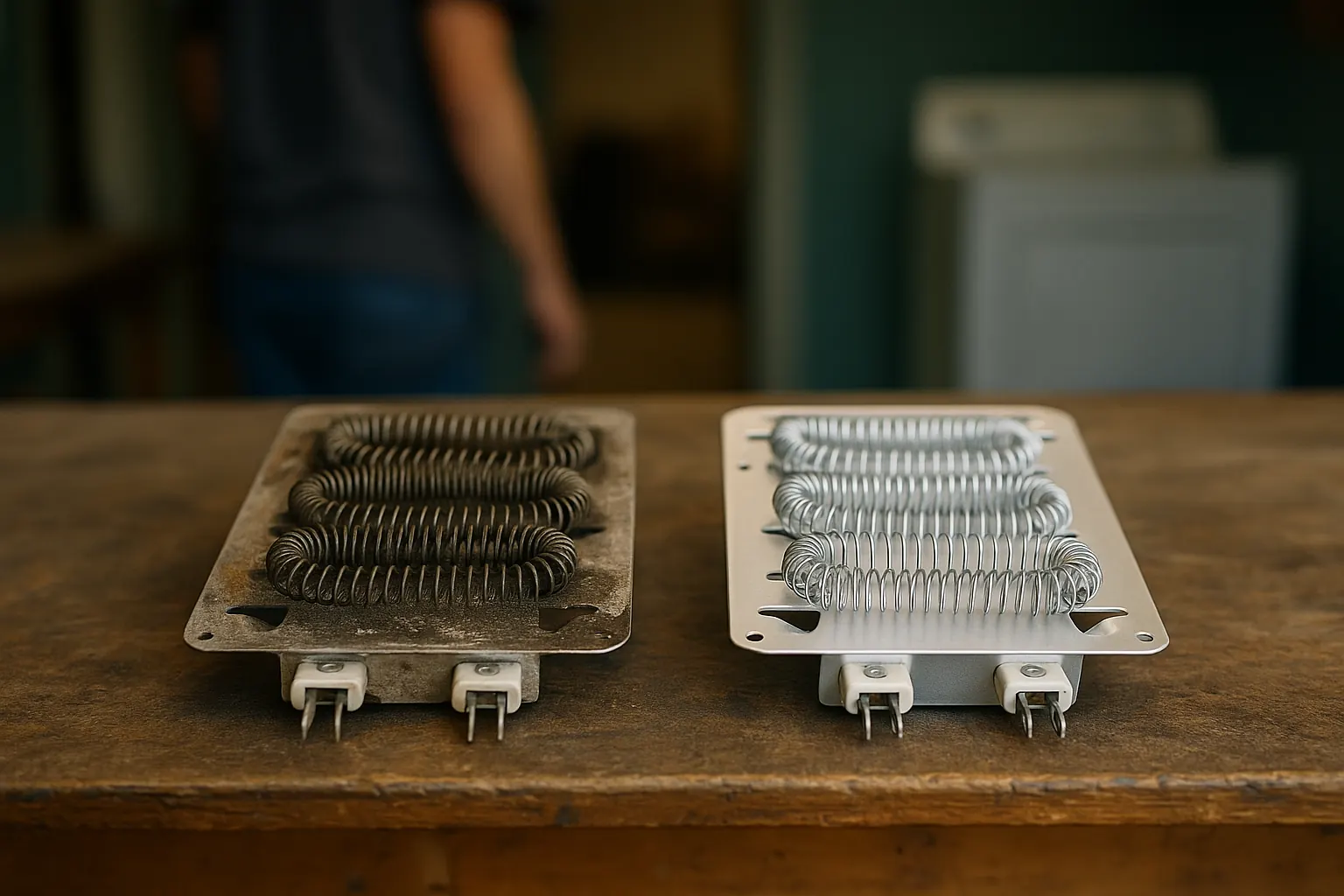
A $40 part and an hour of labor. The dryer's repair economics are the reason it is the safest used purchase in the lineup.
The symptom, before the service call
What the machine does before it dies usually names the part:
- Washer screams or rumbles on spin: bearings. Run the age math before booking anyone; on a unit past 7 years this is usually the end.
- Washer fills or drains slowly, or leaks at the front: valve, pump, or door boot. Cheap side of the table, worth fixing at almost any age.
- Dryer tumbles but no heat: heating element or thermal fuse. Cheap, fix it. Check the vent first; a blocked vent mimics element failure and costs nothing.
- Fridge warm but the light works, clicking from the back: start relay if the click repeats every few minutes, compressor if it hums and dies. The relay is a $100-class fix; the compressor is the totaling event.
- Fridge cools poorly, back wall iced over: defrost system. Middle of the table, usually worth repairing under 9 years.
- Dishwasher standing water: clogged filter, drain hose, or air gap before pump. Work the cheap list first; half of these calls end with cleaning the filter.
- Gas burner clicks forever without lighting: igniter or spark module. Cheap, fix it, and the same part logic applies to a used range you are inspecting before purchase (how to inspect a used appliance before buying).
Category notes that change the call
Refrigerators (~13 years). The failure that matters is the sealed system. Sealed-system repairs are expensive enough that on units past 8-9 years they usually fail the table. Door seals, fans, relays, and thermostats are cheap repairs worth making at almost any age. If the fridge is already warm and the budget is already gone, the triage steps and the food-safety window are in refrigerator died cant afford a new one.
Washers (~10 years). Drum bearings and transmission failures are the totaling events; pumps, valves, and belts are worth repairing. A bearing failure on a 6-year-old washer sits right at the decision boundary, which is why it is the classic repair-or-replace argument. Front-loaders wear bearings faster under heavy loads, and the early warning is usually water: a failing tub seal lets wash water reach the bearing, so a drip trail under the rear of the machine often shows up months before the roar does.
Dryers (~13 years). The kindest repair economics in the table: long lifespan, simple mechanics, cheap parts. Dryers are usually worth repairing well past the age where a washer is not, and the same simplicity makes them the safest used-appliance purchase on the floor.
Dishwashers (~9 years). Shortest lifespan of the majors. Pumps and control boards on units past 6 years routinely fail the math. Racks and spray arms are consumables, not repairs, and should be priced as accessories when you buy used.
Ranges (~13-15 years). Mechanically the simplest and longest-lived, especially gas. Elements, igniters, and switches are cheap; control-board failures on electronic models are the exception that totals. A basic gas range with mechanical knobs is close to unkillable, which is why it holds value used better than any other category.
Three worked examples
- 7-year-old front-load washer, bearing roar, $450 quote. Age is past 2/3 of the 10-year lifespan, so the bar is 25-30% of replacement. A tested used washer runs ~$350 in most markets. The quote is 129% of that denominator. Replace, without paying for the service call.
- 4-year-old french-door refrigerator, warm, clicking relay. Age is under 1/3 of 13 years, so the bar is 50% of replacement, and the likely fix is a $100-class relay against a $1,500-plus replacement. Book the diagnosis; repair.
- 8-year-old dishwasher, dead mid-cycle, $325 pump-assembly quote. Past 2/3 of a 9-year lifespan, so the bar is 25-30% of a ~$550 replacement, a ceiling of ~$165. The quote is double the ceiling. Replace, and put the $325 toward a scratch-and-dent unit.
The maintenance that actually moves the table
Most maintenance advice is filler. Five habits measurably shift where a machine lands against its lifespan, and they are the same five that show up as failure causes in the symptom list above:
- Washer: leave the door open between loads and wash the boot monthly. Front-loader mold is a resale-killing, gasket-rotting problem that costs nothing to prevent. And never overload: suspension and bearings price every overstuffed comforter into the machine's retirement date.
- Dryer: the vent, twice a year. A packed vent doubles dry times, cooks the element, and is the fire risk the safety statistics keep pointing at. A $10 brush kit and twenty minutes.
- Refrigerator: vacuum the coils yearly, two years max. Dirty coils force the compressor to run hot and long, and the compressor is the one part you cannot afford. The gasket wipe-down rides along free.
- Dishwasher: clean the filter monthly. Modern dishwashers have manual filters; a clogged one mimics a failing pump and grinds food back onto dishes, and half of "broken dishwasher" service calls start here.
- Range: keep burner ports clear, keep spills off the control panel. Boiled-over sugar under a knob panel is how mechanically immortal ranges end up with $300 electronic problems.
Ten minutes a month, and the practical effect is moving a machine from the market's average lifespan toward its design lifespan, which on the table above is worth years. The same habits, read in reverse, are an inspection tool: a used machine's vent, coils, filter, and boot tell you exactly how its previous decade went (how to inspect a used appliance before buying makes that read systematic).
What a decade of ownership actually costs, per path
The repair-or-replace call repeats over a machine's life, so the honest comparison is decade cost, not incident cost. Worked on a washer, the category with the least kind economics, using the ranges above:
| Path | The decade's spend | Notes |
|---|---|---|
| New mid-range washer, maintained, one mid-life repair | $650 + $180 = ~$830 | The baseline everything else beats or fails |
| Tested used washer at year 4 of 10, guarantee, replaced once more | $350 + $350 = ~$700 | Two machines, both bought on the right side of the age table |
| Cheap used washer past 2/3 life, replaced every 2-3 years | $250 × 4 = ~$1,000 | The false economy: the most spent and the most Saturdays lost |
| New machine, zero maintenance, repaired at each symptom | $650 + $250 + $400 = ~$1,300 | The repair-everything reflex on an aging unit |
The two middle rows are the whole argument of this page in dollars: buying used early in a machine's life beats everything, and buying used late in a machine's life on repeat is the most expensive laundry in town. The age-adjusted thresholds exist to keep you in row two and out of rows three and four.
When replacement wins, buy the replacement well
Once a unit fails the table, the decision becomes which replacement channel: new, used, scratch-and-dent, or open-box, defined and compared in used vs. scratch-and-dent vs. refurbished vs. open-box. The remaining-life formula in is buying used or scratch-and-dent worth it is this page's math run in reverse, and the store-vetting checklist is how to verify a used-appliance store.
The supply is real: 1,987 of the 6,671 active listings in our directory show positive evidence of selling used inventory, and 2,033 stores score 80 or higher on our published verification checks (both checked 2026-07-15). Two practical notes from the same dataset before you drive anywhere: only 48.0% of stores (3,199 of 6,671) have a live website, and only 28.5% (1,902) publish a checkable phone number, so the store you cannot find online may still be the deepest-stocked floor in your county. Local supply for every segment is on the browse checked stores by state, for example Tampa.
The other half of replacement: most municipalities collect appliances on bulk-pickup days, and scrap collectors usually beat them to it.
If the replacement budget itself is the blocker, the honest comparison of the no-credit routes is buying appliances with bad credit, and the cheapest full path from dead machine to working machine is cheapest way to replace a washer or dryer.
Sources
- National Association of Home Builders / Bank of America, Study of Life Expectancy of Home Components, 2007.
- Industry-standard 50% repair-cost rule of thumb (a decision heuristic, not a measured study; the age adjustments above are our stated refinement of it).
- Repair-quote ranges: typical out-of-warranty parts-plus-labor ranges across published service-price lists, checked 2026; stated as ranges, not a survey.
- usedappliancestores.com store dataset, 2026-07-15 build: 6,671 active listings; used-inventory evidence, verification scores, website and phone coverage.