Last updated: 2026-08-03 · Written by the usedappliancestores.com data team. This page explains the legal framework in plain language and links each state claim to its statute. It is general information, not legal advice; for a dispute, consult your state consumer-protection office or an attorney.

Used appliances usually do come with a warranty, and most buyers sign it away at the counter without knowing it. Three layers of law govern the purchase: federal warranty law (the Magnuson-Moss Warranty Act), your state's version of the Uniform Commercial Code (the implied warranty of merchantability), and any state consumer-protection rules layered on top. The first layer is the same everywhere. The second exists in every state and is the warranty you already have before anyone writes anything, and in most states the words "as is" on a receipt erase it. The third layer is where states genuinely differ: seven jurisdictions flatly bar that erasure on a used appliance, three more allow it only with strict signed or itemized disclosures, and if you live in one of them, the as-is ticket you signed may not mean what the seller thinks it means.
The warranty you have before anyone writes anything
Every state has enacted the Uniform Commercial Code's Article 2 in some form, and with it the implied warranty of merchantability (UCC §2-314): goods sold by a merchant carry an unwritten promise that they work for their ordinary purpose. It applies to used goods sold by merchants; a used washer that cannot wash clothes breaches it, written warranty or not. The implied warranty is not a quality guarantee, and a used appliance is held to the standard of a used appliance, not a new one. But "it runs" is the floor, and a unit that fails within days of an ordinary purchase from a dealer starts the conversation below that floor.
The catch is disclaimer. Under the UCC's default rule (§2-316(3)(a)), a merchant can eliminate the implied warranty with conspicuous "as is" or "with all faults" language, which is exactly why those words appear on used-appliance sales tickets. Whether that default rule survives in consumer sales is the state-by-state question this page tracks.
The federal layer: Magnuson-Moss
The Magnuson-Moss Warranty Act (15 U.S.C. §2301 and following) governs written warranties on consumer products. What it does and does not do for a used-appliance buyer:
- It does not require any warranty. A seller may offer none. The Act regulates warranties that are offered, not whether they exist.
- If a written warranty is offered, it must be available to read before purchase, labeled as "full" or "limited," and stated in plain terms. A store's written 90-day guarantee on a used washer falls under this framework.
- A written warranty kills "as is." Under 15 U.S.C. §2308, a seller who gives a written warranty (or sells a service contract) may not disclaim the implied warranties during its term. This is the quiet power of the written guarantee: it is not just its own 90 days of coverage, it restores the implied-warranty floor underneath itself.
The practical consequence inverts the sales floor's usual framing. The store's "we give a 90-day guarantee" and "this one's as-is, that's why it's cheap" are not two versions of the same product at different prices. They are different legal transactions, and the second one strips protections the first one federally locks in.
The states that restrict or prohibit "as is" consumer sales
Twelve jurisdictions restrict sellers from disclaiming implied warranties in consumer sales, and for a used-appliance buyer they sort into three groups that behave differently at the counter. Every row below was verified against the state's statute (official legislative site or published statutory text; dates per row).
Group one: as-is is simply void on a used appliance. Seven jurisdictions bar the disclaimer outright in consumer sales, used goods included:
| Jurisdiction | Effect on an as-is used-appliance sale | Statute | Verified |
|---|---|---|---|
| Massachusetts | Seller language excluding implied warranties or remedies on consumer goods is unenforceable, and the protection cannot be waived by agreement | Mass. Gen. Laws ch. 106, §2-316A | 2026-08-03, official legislative site |
| Maryland | As-is language is unenforceable in consumer-goods sales; §2-316's disclaimer rules do not apply | Md. Code, Com. Law §2-316.1 | 2026-07-30, statutory text |
| West Virginia | Merchants may not exclude or limit implied warranties in consumer transactions | W. Va. Code §46A-6-107 | 2026-07-30, official code site |
| District of Columbia | Exclusion language is unenforceable; narrow exception for specific defects conspicuously noted in writing at sale | D.C. Code §28:2-316.01 | 2026-07-30, official code site |
| Maine | Exclusion language is unenforceable on consumer goods, defined to include new or used goods; a violation is also an Unfair Trade Practices Act violation | 11 M.R.S. §2-316(5) | 2026-08-03, official legislative text |
| Mississippi | No disclaimer of implied warranties in consumer sales, and the rule cannot be waived or varied by agreement | Miss. Code §75-2-316 (2014, replacing repealed §75-2-315.1) with §11-7-18 | 2026-08-03, statutory text and bill record |
| Kansas | Suppliers may not exclude or limit implied warranties; the one exception is a specific defect the consumer actually knew of and bargained over | Kan. Stat. §50-639 | 2026-08-03, statutory text |
Group two: as-is works only with strict formalities. Three states allow the disclaimer on used consumer goods, but only when it is done conspicuously and specifically, which the standard rubber-stamped ticket rarely satisfies:
| Jurisdiction | What the seller must actually do | Statute | Verified |
|---|---|---|---|
| Minnesota | A conspicuous writing, before the sale, plainly disclosing the as-is basis and that the buyer takes the entire quality risk | Minn. Stat. §325G.18 | 2026-07-30, statutory text |
| New Hampshire | A conspicuous writing signed by the buyer at or before sale, stating the as-is basis, the buyer's assumption of the entire risk, and the buyer's responsibility for all repair costs | N.H. RSA 382-A:2-316(4) | 2026-08-03, official legislative site |
| Washington | The disclaimer is effective only insofar as it "sets forth with particularity the qualities and characteristics which are not being warranted"; a generic as-is stamp does not qualify | RCW 62A.2-316(4) | 2026-08-03, official legislative site |
Group three: protection for new goods only. Two states bar warranty disclaimers on new or unused consumer goods, which means their protection does not reach a used-appliance purchase; they are listed because the standard lists lump them in, and a used buyer should not rely on them:
| Jurisdiction | Scope | Statute | Verified |
|---|---|---|---|
| Connecticut | Disclaimer bar applies to new or unused consumer goods (with irregular/factory-second/damaged carve-outs); used goods fall back to the standard as-is rule | Conn. Gen. Stat. §42a-2-316(5) | 2026-08-03, statutory text |
| Vermont | Same structure: the bar covers new or unused consumer goods; used goods are outside it | 9 V.S.A. §2-316(5) | 2026-08-03, statutory text |
Two special cases sit outside the tables. California permits as-is sales with proper disclosure, but the Song-Beverly Act's used-goods provision changes the deal the moment a seller offers any express warranty on a used unit: the retailer or distributor then also owes an implied warranty of merchantability, running at least 30 days and up to three months from sale (Cal. Civ. Code §1795.5; verified 2026-08-03, official legislative site). In California, a store's written 90-day guarantee therefore carries a statutory implied warranty with it. Louisiana never adopted UCC Article 2; its civil-law warranty against redhibitory defects covers used goods, and a waiver works only if it is clear, unambiguous, and actually brought to the buyer's attention (La. Civ. Code arts. 2520-2548; verified 2026-08-03), which is a higher bar than a stamp on a ticket.
In the remaining states, the standard UCC rule applies: a conspicuous as-is disclaimer is effective, including in consumer sales and on used goods, and the written guarantee you negotiate is the coverage you have. The operative rule is the uniform §2-316(3)(a) text as enacted in each state's commercial code.
What "conspicuous" and the other escape hatches mean
Even where as-is disclaimers are legal, they have requirements, and failed requirements are your leverage in a dispute:
- The disclaimer must be conspicuous. Buried small print that a reasonable buyer would miss does not qualify under §2-316. A verbal "everything's sold as-is here" with no writing is weaker still.
- It must come before or with the sale. An as-is stamp appearing for the first time on a receipt handed over after payment is a classic failed disclaimer.
- Oral promises fight written disclaimers badly, so get the promise on the paper. If the seller says "if it dies this month, bring it back," that sentence belongs on the receipt. What is written wins, in every state.
- A seller's conduct matters. A store that takes the unit back for repair after an "as-is" sale is behaving like a warrantor, and that conduct is evidence in a consumer-protection complaint.
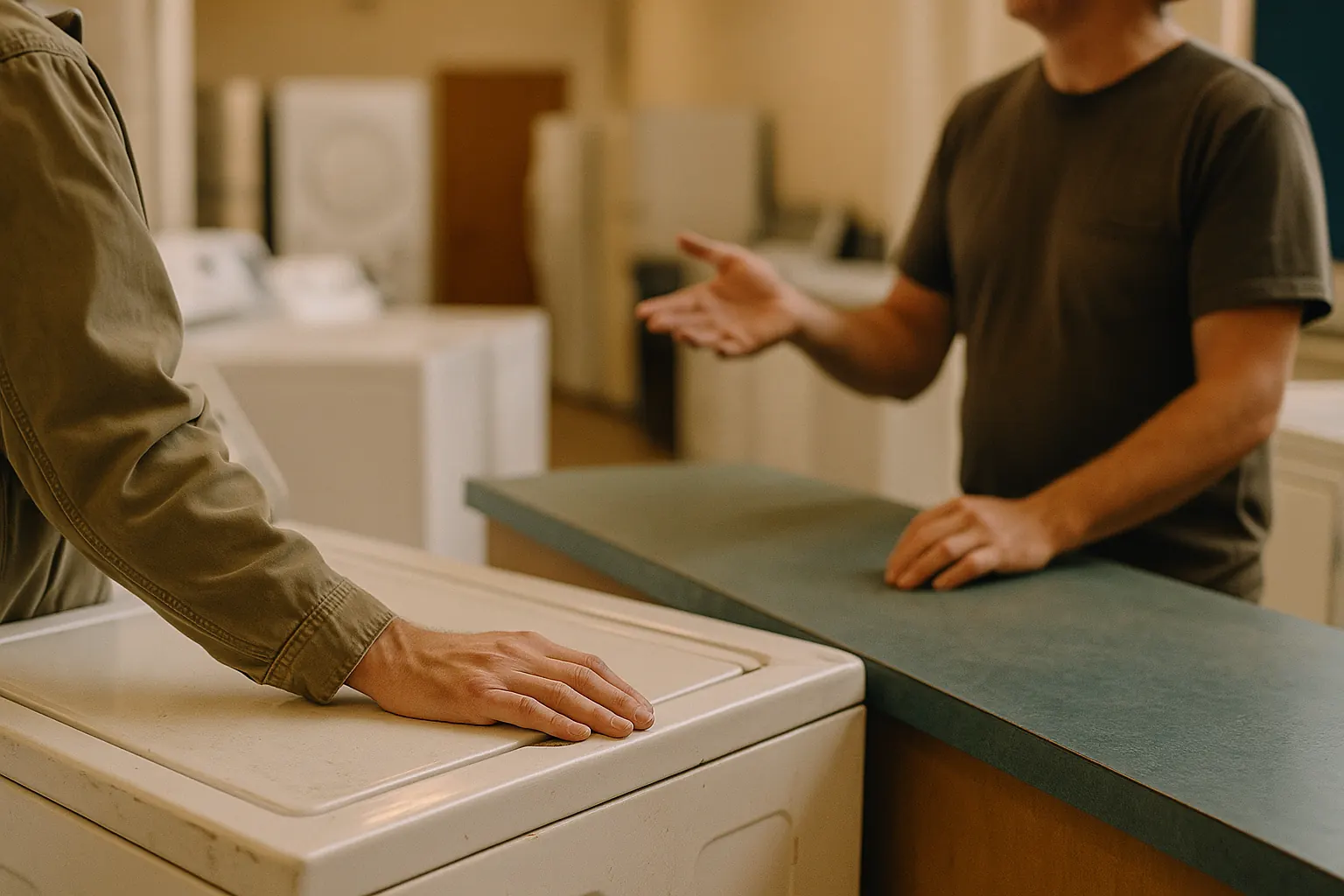
The sentence that matters is the one that makes it onto the receipt.
What to do at the counter, in any state
- Ask for the store's guarantee in writing: length, parts/labor/exchange, who services. The written guarantee is one of the seven checks in how to verify a used-appliance store, because it is the strongest store-quality signal we know how to check.
- If the ticket says "as is," know your state's row above. In most states you are waiving the implied warranty, and the price should reflect the risk you just absorbed (used-appliance prices by type and region carries that arithmetic). In the group-one jurisdictions above, the waiver is void regardless of what you signed; in the group-two states, it is void unless the seller ran the full disclosure drill.
- Keep the receipt and the written guarantee together; both are the case file if the unit fails.
- If a fresh purchase fails and the store refuses its written guarantee, the escalation path runs: written demand to the store, then the state consumer-protection office (every state attorney general runs one), then small claims, where the receipt-and-guarantee file does the talking. The implied-warranty argument belongs in that file even after an as-is sale if you are in a restrictive state.
The economics behind rule 1, from our dataset: sellers who put guarantees in writing are self-selecting into accountability, and the ones who will not are telling you the price of the discount. Of the 6,671 active stores in our directory, only 3,199 (48.0%) have a live website and only 1,902 (28.5%) publish a checkable phone number (checked 2026-07-15), so for roughly half the market the written guarantee is the only durable accountability artifact a buyer holds. Get it.
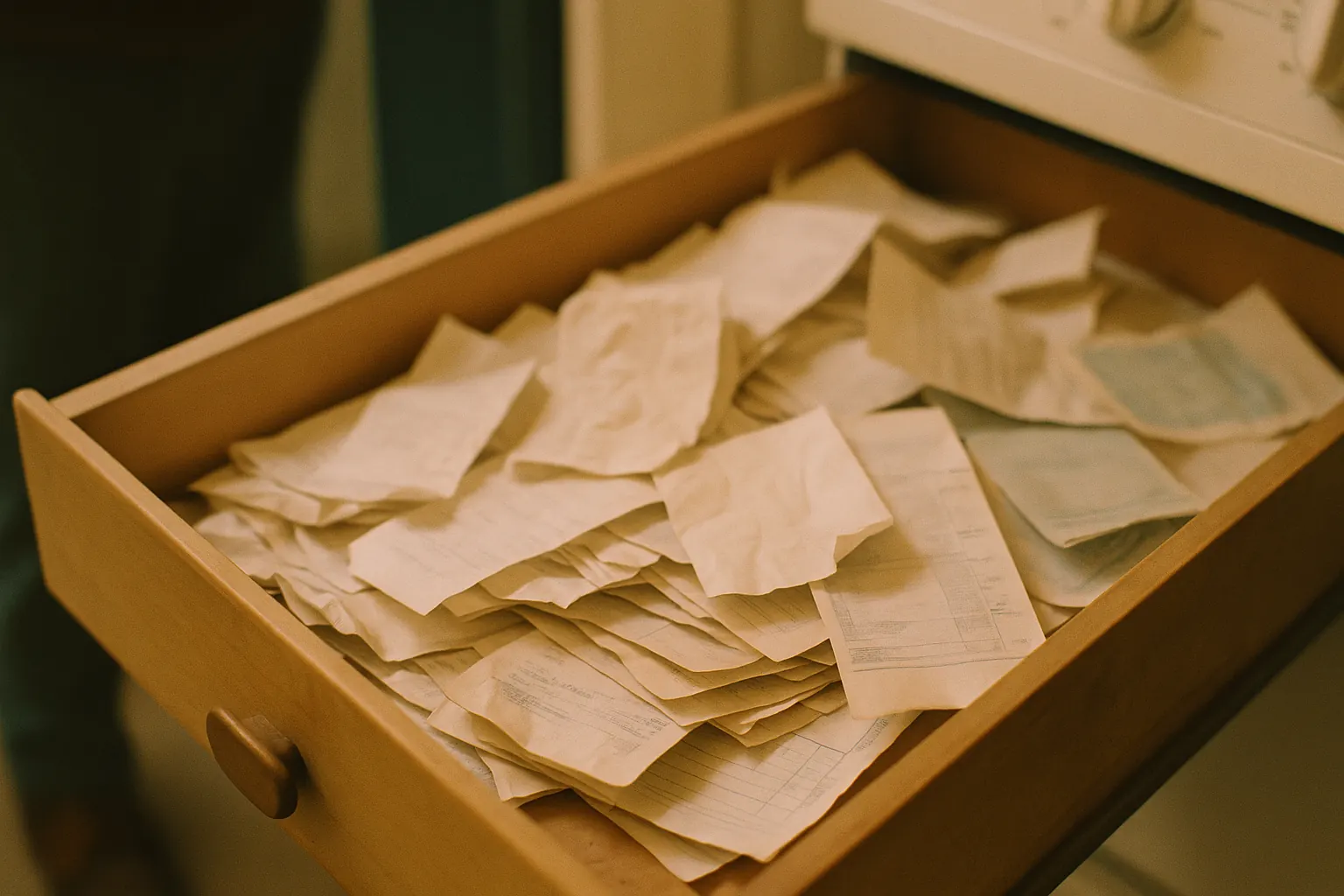
The case file: receipt, written guarantee, and the date. Disputes are won by whoever kept the paper.
What a good written guarantee actually says
Since the written guarantee is the strongest protection in most states, it is worth knowing what a complete one contains, both to recognize it and to ask for the missing piece by name:
| The term | The strong version | The weak version |
|---|---|---|
| Length | A stated number of days from delivery (30/60/90) | "We stand behind our stuff" |
| Scope | Parts and labor | Parts only, labor at $95/hour |
| Remedy | Repair, exchange, or refund, in that order, stated | Store credit only |
| Who services | The store's own tech or a named servicer | "Bring it back in" (you haul, both ways) |
| Delivery failures | Covered as part of the sale | Unmentioned |
| Signature | On the receipt, with the date | A verbal summary of a policy nobody can find |
None of this requires a lawyer to draft; the whole strong column fits in two sentences on a receipt, and stores that test their units write it without being pushed. If a store's version is missing one term, ask for that term by name ("does that cover labor?") and get the answer added in ink. Under Magnuson-Moss, remember, the existence of this written warranty also blocks an as-is disclaimer of the implied warranties during its term, so the two sentences on the receipt are carrying federal weight.
If it fails anyway: the escalation, priced
Small claims is the venue these disputes actually resolve in, and it is built for exactly this size of problem: filing fees typically run $30 to $75, no attorney is required, and the courts' dollar limits ($2,500 to $25,000 depending on state) dwarf any appliance dispute. The sequence that wins there is boring and mechanical: the written demand letter first (dated, specific, "repair, replace, or refund within 14 days," sent so you can prove it arrived), the consumer-protection complaint next (every state attorney general takes them online, and a pending complaint changes negotiations), and the filing last, with the receipt, the written guarantee, the photos, and the demand letter as the whole case. Most disputes settle at the letter, some at the complaint, and few merchants with registry filings and storefronts let a documented case reach a hearing. Which is the deeper point of this whole page: the paper you collect at the counter on purchase day settles the entire dispute, pre-won or pre-lost, months before anything breaks.
How this interacts with the label on the tag
The categories defined in used vs. scratch-and-dent vs. refurbished vs. open-box each carry their own warranty posture: scratch-and-dent and open-box units may retain manufacturer coverage (confirm in writing, including whose purchase date starts the clock), refurbished units carry the refurbisher's warranty or none, and used units carry the store's written guarantee or the implied-warranty floor alone. "As is" stacked on any of those labels overrides the label, subject to your state's row above. The one combination that should always stop you: a "refurbished" premium price on an as-is ticket, which asks you to pay for accountability the paper explicitly removes.
Sources
- Magnuson-Moss Warranty Act, 15 U.S.C. §2301 et seq., including §2308 (implied warranties may not be disclaimed during a written warranty's term).
- Uniform Commercial Code §2-314 (implied warranty of merchantability) and §2-316 (exclusion or modification), uniform text.
- W. Va. Code §46A-6-107, official West Virginia Code site, checked 2026-07-30.
- Md. Code, Commercial Law §2-316.1, statutory text, checked 2026-07-30.
- D.C. Code §28:2-316.01, official DC Council code site, checked 2026-07-30.
- Minn. Stat. §325G.18, statutory text, checked 2026-07-30.
- State statutes as cited per row, verified 2026-07-30 to 2026-08-03 against official legislative sites (MA, NH, WA, CA, WV, DC) and published statutory text (MD, MN, ME, CT, VT, MS, KS, LA), including the 2014 Mississippi recodification (H.B. 96: §75-2-315.1 repealed, §75-2-316 enacted).
- Consumer Reports, "What you need to know about warranty laws": the starting list of jurisdictions restricting as-is consumer sales, refined by the statute-level pass above (Connecticut and Vermont protect new goods only).
- usedappliancestores.com store dataset, 2026-07-15 build.