Last updated: 2026-08-03 · Written by the usedappliancestores.com data team. Store counts come from our national dataset of 6,671 active store listings, checked 2026-07-15.

Ranked by total cost, the routes to a working appliance run: used cash purchase, then new cash purchase, then short-term financing paid on schedule, then rent-to-own. Ranked by accessibility with no credit, the order roughly reverses. That inversion is the whole subject. Every route on this page trades money for one of three things: speed, newness, or access without a credit file, and the only way to choose well is to see the full price of each trade on the same appliance. This page prices all of them with sourced multipliers, at three price points, so the arithmetic is checkable.
The comparison, on a $500 reference appliance
| Route | Upfront | Total cost pattern | Credit check | You own it | Source for the cost figure |
|---|---|---|---|---|---|
| Buy used, cash | Full used price | The used price, once (see the pricing formula in used-appliance prices by type and region) | No | Immediately | Structural: no financing layer exists |
| Buy new, cash | $500 | $500 | No | Immediately | Reference price |
| Buy-now-pay-later (pay-in-four) | ~$125 | ~$500 if paid on schedule; late fees added otherwise | Soft or none | Immediately | CFPB describes the standard product as four equal installments, interest-free when paid on time |
| Credit card, carried 12 months | $0 | ~$550 to $560 | Yes | Immediately | Federal Reserve G.19: average rate on interest-assessed card accounts has run above 20% through 2024-2025 |
| Store financing, 12-month deferred interest | $0 | $500 if cleared in 12 months; $600+ if not | Yes | Immediately | Deferred-interest terms: unpaid balances accrue interest retroactively from the purchase date |
| Rent-to-own, full term | First payment | ~$1,000 to $1,500 | No | At the end of the term, or at early buyout | FTC consumer guidance: rent-to-own typically totals 2-3x retail; Rent-A-Center's 2024 10-K discloses pricing at 2.0-2.4x item cost |
The multipliers are the story. On the FTC's 2-3x figure, the $500 appliance costs $1,000 to $1,500 through a full rent-to-own term, and the industry's own securities filings corroborate the range. Neither number is an accusation. It is the disclosed price of the product's real features, which are worth naming precisely before you pay for them.
The same math at three price points
The multiplier compounds with the price of the machine, so the dollar gap between routes spreads as the ticket grows. Computed from the sourced multipliers above; rent-to-own shown at the FTC's 2x to 3x band.
| Route | $350 used-grade washer | $500 mid-range washer | $1,200 french-door refrigerator |
|---|---|---|---|
| Used, cash | $350 | not applicable | ~$700 (comparable used unit) |
| New, cash | not applicable | $500 | $1,200 |
| Pay-in-four, on schedule | $350 | $500 | $1,200 |
| Card at ~21% APR, carried 12 months | ~$390 | ~$558 | ~$1,335 |
| Rent-to-own, full term | $700 to $1,050 | $1,000 to $1,500 | $2,400 to $3,600 |
| Spread, cheapest route to priciest | $700 | $1,000 | $2,900 |
The refrigerator column deserves the stare. On a $1,200 unit, the gap between buying a comparable used one for cash and renting-to-own the new one runs to nearly $3,000, enough to buy a used washer, dryer, and refrigerator twice over. The larger the appliance, the more the route decision matters, and the more a week of shopping pays.
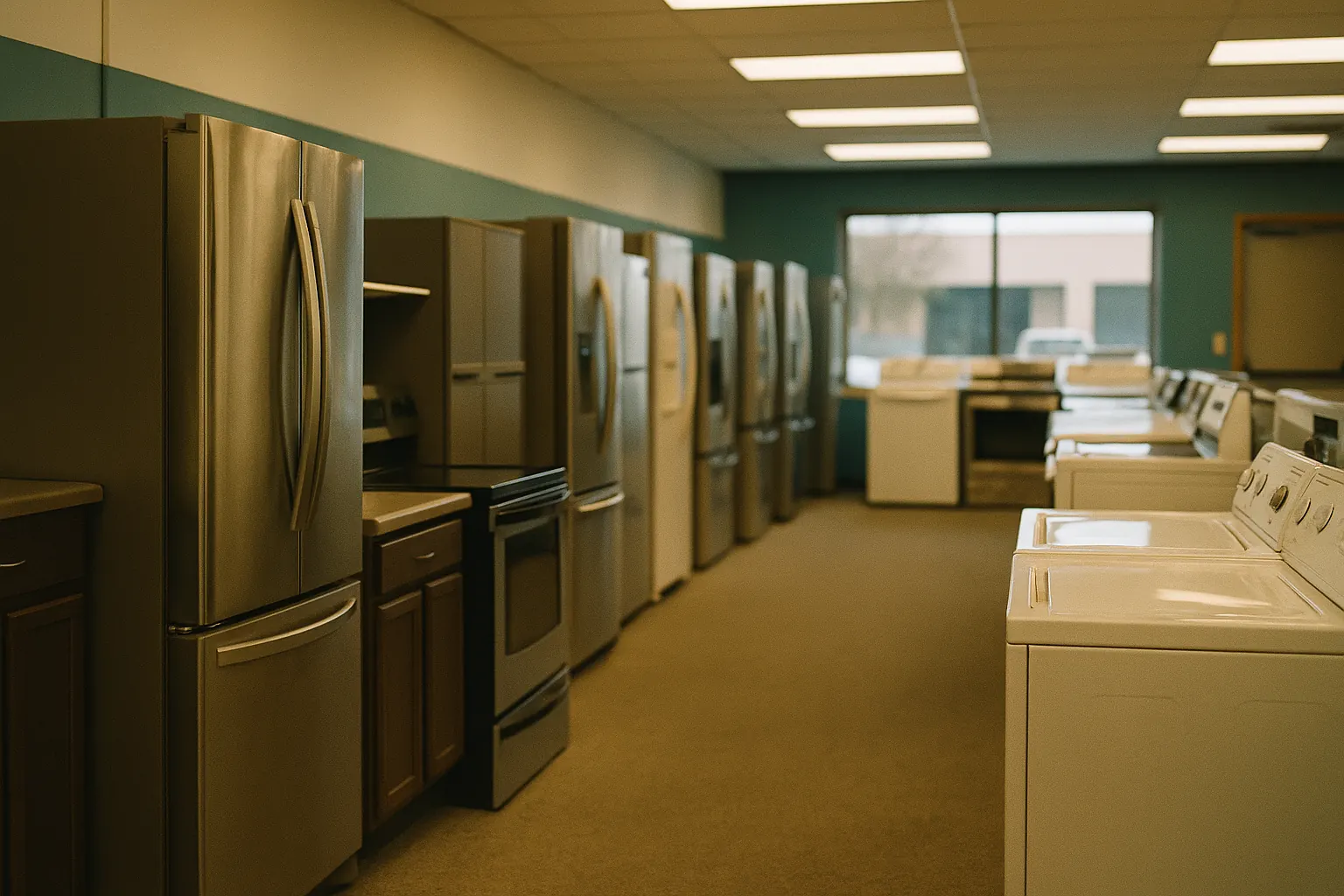
The showroom sells the payment, not the price. The payment is real. So is the multiplier behind it.
What does rent-to-own actually buy you?
Four features, none of them free:
- No credit check. The transaction is a lease, not a loan, so approval does not run through your credit file.
- Immediate delivery of a new unit with no accumulated cash.
- A walk-away right. Return the item and payments stop. There is no repossession mark or collections balance on the item itself, though the payments already made are gone.
- Service during the term, typically included while you rent.
If you will genuinely use the walk-away right (a 6-month work placement, uncertain housing, a job that may move you), rent-to-own can be rational: you are renting, and renting has a defensible price. If you intend to keep the appliance the whole term, you are choosing to pay 2-3x for it, and the used-cash route almost always beats it.
Two mechanics inside the contract change the math and are worth asking about by name:
- Early purchase options. Most agreements carry a same-as-cash window (often 90 to 120 days) in which paying the remaining cash price closes the deal near retail, and after that window an early-purchase formula that still beats riding the full term. If there is a realistic path to accumulating the cash inside the window, same-as-cash converts rent-to-own into a no-credit-check layaway, which is its one genuinely cheap use. Get the window's length and the buyout formula in writing before signing, not after.
- The walk-away math. Payments made before a return buy nothing but the weeks of use. Returning a $25-a-week washer after 20 weeks means $500 spent for five months of laundry, which is fair as rent and terrible as a purchase attempt. Decide which one you are doing before the first payment, not after the twentieth.
Reading a rent-to-own contract: the five numbers
Every rent-to-own agreement contains five numbers, and the sales conversation is built around showing you only the first. Find all five before signing; state disclosure laws in most states require them to be findable:
- The periodic payment. The number on the sign. $25 a week sounds like $25; it is $1,300 a year.
- The cash price. What the store would sell the unit for outright today. This is the denominator for every other judgment, and a cash price already 30% above retail means the multiplier starts before the lease does.
- The total of payments. Payment × term length: the real price of riding the full agreement. Divide it by the cash price yourself; that quotient is your personal copy of the FTC's 2-3x figure, computed on your actual contract.
- The early-purchase formula. The same-as-cash window (commonly 90 to 120 days) and the after-window formula. This number is the difference between rent-to-own as layaway and rent-to-own at full multiplier.
- The fees around the edges. Delivery, processing, reinstatement after a missed payment, and liability-damage waivers, which can add 10% quietly.
The one-sentence test at the counter: "what is the cash price, and what do I pay in total if I go the full term?" A store that answers both plainly is selling a legal product at a disclosed price. A store that answers with the weekly payment a third time has answered the real question too.
What buying used actually costs
The used cash purchase has no financing layer, so the total cost equals the purchase price, once, plus delivery if you cannot move the unit yourself. The trade-offs are the accumulation problem (you need the cash now) and the lifespan risk, which is manageable with the remaining-life math in is buying used or scratch-and-dent worth it and a ten-minute inspection (how to inspect a used appliance before buying).
In our national directory, 1,987 of 6,671 active store listings show positive evidence of selling used inventory (checked 2026-07-15), so in most metros the supply exists (browse checked stores by state). Vet the store first: how to verify a used-appliance store is the checklist we run on every listing, and each store page shows its result.
The strongest version of this route: a tested used unit from a checked store with a written 90-day guarantee. That combination approaches the reliability of financed-new at a fraction of the total cost.
The cost of waiting, priced honestly. The used route's real obstacle is that it needs cash before delivery, and waiting has costs of its own: laundromat machines run $3 to $6 a load, so a family doing five loads a week spends $15 to $30 weekly while saving toward a washer. Six weeks of that is $90 to $180, which is real money and still a fraction of the $500 to $1,000 premium a full rent-to-own term adds on the same machine. If the dead appliance is a refrigerator, the waiting cost is spoiled food and daily takeout, the math compresses to days instead of weeks, and refrigerator died cant afford a new one walks that specific emergency end to end.
What the financing routes cost
Pay-in-four BNPL splits the price into four installments, interest-free when paid on schedule per the CFPB's description of the standard product. The cost appears when payments slip: late fees, and with some providers, longer interest-bearing plans that sit beyond the pay-in-four product. On a $500 unit, pay-in-four means $125 down and three more $125 payments two weeks apart, which suits a buyer with steady income and no accumulated cash.
A carried credit-card balance prices at the card's APR. The Federal Reserve's G.19 series puts the average above 20% on interest-assessed accounts through 2024-2025, roughly $50 to $60 of interest to carry $500 for a year. Cheaper than rent-to-own by a wide margin, but it requires the card and the available limit, and it raises utilization on your file while it rides.
Store deferred-interest financing ("no interest if paid in full in 12 months") is $500 if you clear it and materially more if you do not, because deferred-interest terms charge interest retroactively from the purchase date on the full original balance when the window closes with anything unpaid. A fine product for a buyer certain to clear it. A trap for anyone who is not certain.
Both card routes require a credit profile, which is exactly what excludes part of this page's audience. The full set of no-credit and thin-credit routes, priced the same way, is in buying appliances with bad credit.
The decision table
| Your situation | Cheapest workable route |
|---|---|
| You have the cash and time to shop | Used, from a checked store, written guarantee |
| You have most of the cash | Pay-in-four on a new or scratch-and-dent unit, paid on schedule |
| No cash accumulated, stable income, keeping the appliance | Save 4-8 weeks toward a used unit; the 2-3x rent-to-own multiplier is the price of not waiting |
| No cash, immediate need, uncertain horizon | Rent-to-own, using the walk-away right deliberately |
| No cash, immediate need, keeping it | Rent-to-own only with a written plan to hit the early-purchase window |
| No credit file at all | Used cash or rent-to-own; both skip the credit check |
Every route ends in the same place: a machine that works. The difference is what you paid to get there.
Rent-to-own providers include the national chains and regional companies such as appliancerentals.com. Disclosure: this site and appliancerentals.com are commonly owned. That link is one option inside the comparison above, and the cost math on this page applies to every rent-to-own provider equally, including that one. Details of the ownership are on the about page.
Sources
- Federal Trade Commission, consumer guidance on rent-to-own costs (typical total 2-3x retail).
- Rent-A-Center 2024 Form 10-K (pricing disclosed at 2.0-2.4x item cost).
- Consumer Financial Protection Bureau, descriptions of the pay-in-four buy-now-pay-later product and of deferred-interest promotions.
- Federal Reserve, G.19 Consumer Credit series (average APR on interest-assessed credit-card accounts, 2024-2025).
- usedappliancestores.com store dataset, 2026-07-15 build: 6,671 active listings; used-inventory evidence counts.
- Laundromat per-load machine fees: typical posted prices, 2026 spot checks; stated as a range, not a survey.